
Most people think about injury prevention as something you do after you get hurt: rest, ice, a few visits, back to normal. The research points the other way. What you do in the weeks before an injury, in the gym or at home, may decide whether it happens at all. A large body of evidence now shows that building strength on a regular schedule is one of the most reliable ways to lower your risk of getting hurt.
What the Research Found
In 2014, Lauersen and colleagues published a systematic review and meta-analysis in the British Journal of Sports Medicine that pooled randomized controlled trials of exercise programs meant to prevent sports injuries.
Authors’ conclusion
Consistently favorable estimates were obtained for all injury prevention measures, except for stretching. Strength training reduced sports injuries to less than 1/3 and overuse injuries could almost be halved.
Lauersen et al., 2014
The benefit was not limited to one kind of injury. Strength work lowered the rate of acute injuries, such as sprains, strains and tears, and it also lowered the rate of overuse injuries, such as tendon pain that builds up from repeated stress.
How Strength Training Compares With Other Methods
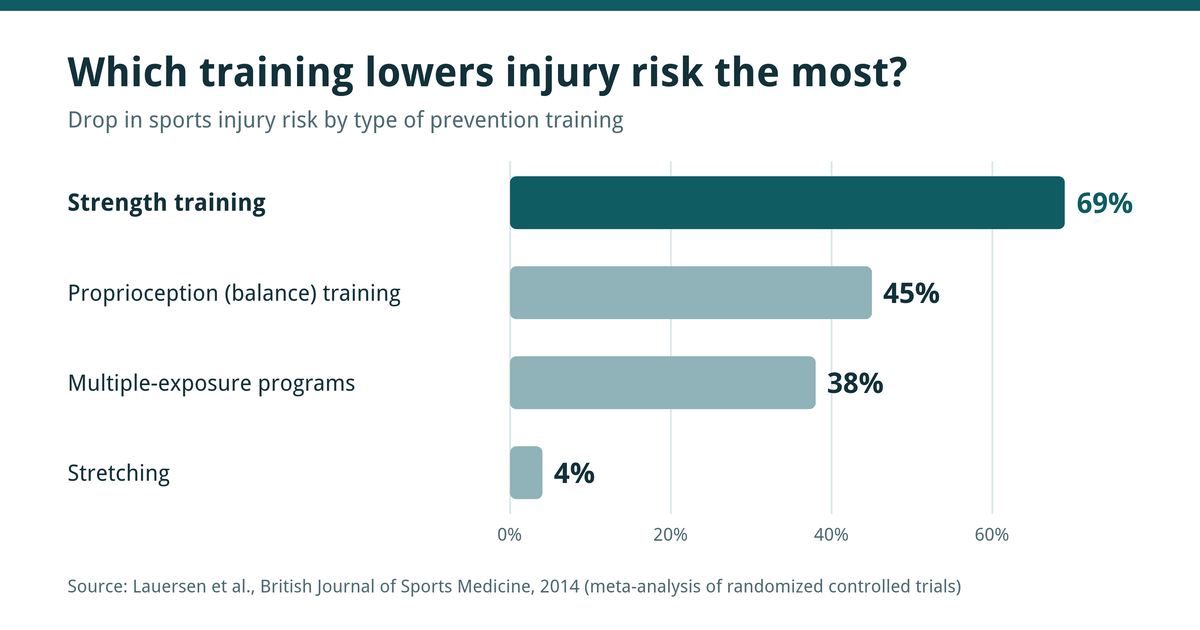
The same research compared several kinds of injury-prevention training. Here is the drop in injury risk for each one:
Balance work and mixed programs still help, and stretching has its place for comfort and range of motion. But if your goal is to avoid getting hurt, strength work gave the biggest benefit in this research.
Why the Amount of Training Matters
A later review by the same group in 2018 (Lauersen, Andersen and Andersen, PubMed) described strength training as a dose-dependent way to prevent both acute and overuse sports injuries. In plain terms, programs with more training volume or higher intensity gave better protection than lighter ones. A single hard session will not do much. A program you follow for months, and that gets a little harder over time, is what builds the protection.
That does not mean everyone should lift as much as possible. Your plan still has to fit your current fitness, how well you recover, and any past injuries. The point is that steady, progressive work beats occasional effort.
What the Research Cannot Tell You
A meta-analysis combines many studies, so its results describe groups of people, not any one person. The trials also used different sports, age groups and program designs. Your own risk depends on your training history, your job, your sleep, past injuries and how your body moves. That is why a good program is built around you, not copied from an average. It is also why a short check-up before you start can save you months of setbacks.
How Stronger Muscles Protect You
- Better load handlingMuscles and tendons that are used to heavy work absorb sudden forces from running, jumping and changing direction more safely.
- More stable jointsStrong muscles around the hips, knees, shoulders and spine control motion and take stress off ligaments.
- Slower fatigueA conditioned body holds good form longer, which matters because many injuries happen late in a workout, a game or a long work shift.
- Fewer imbalancesTargeted work can even out differences between your left and right sides that otherwise overload one joint.
This Is Not Only for Athletes
The trials in this review studied athletes, but the idea behind the result applies to everyone. Tissue that is stronger can tolerate more load before it gets injured. That is true for a runner training for a race, a parent lifting a toddler all day, and an office worker whose neck and low back tire out by Friday.
How to Start Safely
- Begin with two or three strength sessions a week that cover the big muscle groups you use most: legs, hips, back, chest and shoulders.
- Learn good form first. Use lighter weights until the movement feels controlled and pain-free.
- Add weight or repetitions gradually, a little at a time, instead of jumping up in one session.
- Plan rest days so your muscles and joints can adapt.
- Stop and get checked if a movement causes sharp or lingering pain.
When to Get Checked Before You Train
Strength training is a good tool, but it works best on a body that moves well. It is worth having a professional look at you first if you have pain that has lasted more than a couple of weeks, numbness or tingling in an arm or leg, pain that gets worse as you add load, or a history of disc problems or past injuries.
Our pages on low back pain, neck pain and sciatica explain what we look for and how we treat each problem.
Where Chiropractic Care Fits In
Dr. Mina Iskander treats patients at our Culver City and Orange offices, including active people who want to keep training and people returning to exercise after an injury. Before you add load, an exam can show whether a joint is stiff, whether one side is compensating for the other, or whether an old restriction is likely to get worse under a heavy bar. If something does go wrong, our sports injury care focuses on getting you moving again, and spinal decompression may help when a disc is involved. You can also read why people choose chiropractic care.
Frequently Asked Questions
Can strength training really lower my risk of injury?
Research says yes. A meta-analysis of randomized controlled trials found that strength training reduced sports injuries to less than one third, and that overuse injuries could almost be halved.
How often should I do strength training?
Two to three sessions a week is a reasonable start for most adults. Later research found that higher volume and intensity gave more protection, so build up slowly over weeks and months.
Is it safe to lift if I already have back or neck pain?
Sometimes, but it depends on the cause. A movement assessment can tell you whether you can train through it with changes or whether the area needs treatment first.
What is the difference between an acute and an overuse injury?
An acute injury happens suddenly, like a sprain or a muscle tear. An overuse injury develops gradually when the same tissue is stressed repeatedly without enough recovery.
Do I need to see a chiropractor before starting a strength program?
Not everyone does, but it helps if you have ongoing pain, past injuries or a job that strains your body. An exam gives you a safe starting point.
Book a Visit
If you want to train with confidence, or pain is already holding you back, schedule a visit with Dr. Mina Iskander.
This article is for general information and is not a substitute for medical advice. Talk with a qualified provider before starting a new exercise program, especially if you have an injury or health condition.
